Whenever you see through your SLR's viewfinder, or on your digital point-and-shoot's LCD screen, you are using one of humanity's oldest inventions: the lens.
This last week, we've been very busy, focusing on photography and it's history, as well as the functioning of a typical SLR. We're now closing with the unknown basics of photography: how lenses work.
A lens is an optical device that transmits, refracts, and concentrates light, as well as having axial simmetry, that is, it is symmetric around an axis, so if you were to rotate the object based on that axis, the appearance and form of the object would result unchanged. Lenses are divided into two categories: Simple lenses and Compound Lenses.
A simple lens is formed by a single optical element, while a complex lens is formed by many different optical elements put together.
The oldest lens in the world, the Nimrud lens, is over three thousand years old, and comes from Iraq (formerly Persia, formerly Assyria). It was simply a piece of rock crystal which may have been used as a magnifying glass, or as a burning lens.
Lenses are regularly a portion of a sphere, with surfaces being convex, concave or planar.
When a lens has two convex surfaces, it is called a biconvex lens. A surface with a planar and a convex surface is named plano-convex. A lens with two concave surfaces is called biconcave, and a lens with a concave and a planar surface is called a plano-concave lens. There's also meniscus lens, which feature a convex and a concave surface.
Convex type lenses focus the light in a spot. Concave type lenses diverge light around an area. Meniscus lenses can be either positive or negative, depending on the thickness of the lens, and the difference of curvature between both lenses.
Mostrando entradas con la etiqueta Optics. Mostrar todas las entradas
Mostrando entradas con la etiqueta Optics. Mostrar todas las entradas
29 ago 2008

25 ago 2008
How an SLR works (Part 1)
Photography has a pleasant je ne sais quoi to it, a way of transmitting feelings in a way other art forms- cinema, painting, poetry, dancing, and etc- fail to transmit. Maybe it’s the fact that, to see a photograph, one does not need to have certain specific traits, like a vast vocabulary or having a massive visual sensibility to understand what exactly does Edvard Munch’s The Scream tries to tell us. Maybe it’s the fact that, it has a way of freezing time cinema or video can’t offer.
In my previous posts, I’ve written about the historical development of photography, all the way back to Ibn Al-Hazen's Camara Obscura, and to more recent times, stopping at the huge development Japanese Optics Corporations had in the 1950's. I'm gonna take a break from the whole history lesson for now, and we'll start on engineering and physics, as to fully understand the way a Single-Lens reflex camera works.
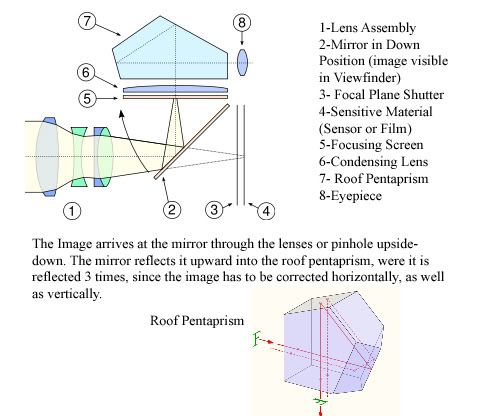
A Single-Lens Reflex camera allows the user to see, throught the viewfinder, the way the picture is to be taken. A mirror is set between the sensitive surface (sensor or film) and the lenses. The mirror is placed at a 45° angle, which makes the light beams, waves, or particles (whichever way you want to see it) travel upward, and hit a focusing screen. The image is proyected on the focusing screen. A roof pentaprism reflects the proyected image 3 times: The first reflection corrects vertical orientation, the second one the horizontal orientation of the image, and the third one reflects the image the way it is seen through the viewfinder. Generally, to add brightness to the image in the viewfinder, there is a condensing lens found between the focusing screen and the pentaprism.
Since the faces in a pentaprism cannot ensure Total Internal Reflection, given the entry angle of light, both reflective surfaces of the pentaprism have to be coated or overlapped with a reflective material.
In early SLRs, the mirror had to be lifted manually before a picture was taken. This made the SLR unpractical and useless for certain photographics tasks. When automatic mirror-rising was introduced, a new problem was born: the vibration caused by the mirror-lifting caused motion blur. Then, in 1959, the Nikon F introduced mirror lockup. Mirror Lock Up allows the mirror to be raised before the Shutter is opened. The vibration dies down , and no motion blur appears on the exposure.
In my previous posts, I’ve written about the historical development of photography, all the way back to Ibn Al-Hazen's Camara Obscura, and to more recent times, stopping at the huge development Japanese Optics Corporations had in the 1950's. I'm gonna take a break from the whole history lesson for now, and we'll start on engineering and physics, as to fully understand the way a Single-Lens reflex camera works.
A Single-Lens Reflex camera allows the user to see, throught the viewfinder, the way the picture is to be taken. A mirror is set between the sensitive surface (sensor or film) and the lenses. The mirror is placed at a 45° angle, which makes the light beams, waves, or particles (whichever way you want to see it) travel upward, and hit a focusing screen. The image is proyected on the focusing screen. A roof pentaprism reflects the proyected image 3 times: The first reflection corrects vertical orientation, the second one the horizontal orientation of the image, and the third one reflects the image the way it is seen through the viewfinder. Generally, to add brightness to the image in the viewfinder, there is a condensing lens found between the focusing screen and the pentaprism.
Since the faces in a pentaprism cannot ensure Total Internal Reflection, given the entry angle of light, both reflective surfaces of the pentaprism have to be coated or overlapped with a reflective material.
In early SLRs, the mirror had to be lifted manually before a picture was taken. This made the SLR unpractical and useless for certain photographics tasks. When automatic mirror-rising was introduced, a new problem was born: the vibration caused by the mirror-lifting caused motion blur. Then, in 1959, the Nikon F introduced mirror lockup. Mirror Lock Up allows the mirror to be raised before the Shutter is opened. The vibration dies down , and no motion blur appears on the exposure.
Suscribirse a:
Entradas (Atom)