Many people cite SLRs as bulky, noisy and complicated. The latter is not true, at least for anyone who reads the manual enclosed with the camera. The second point might just be true: SLRs are noisy. In fact, I rejoice in the noisiness older cameras. This post is all about the noisiness of SLRs, and why we love it!
You now know about the mirror found between the film and the lens. But I didn't tell you about the focal plane shutter. The FPS is a photographic shutter that stops light from making contact with the focal plane (film or sensor) of the camera.
Almost all SLRs feature horizontal double-curtain shutters. In slow shutter speeds, the opening curtain moves to the left, and after the necessary amount of time has passed, the second curtain (which has remained static) moves to the left side, thus, closing the focal plane again. When the shutter is recocked, both curtains move back to their starting positions, ready to be released again.
In faster shutter speeds, the second curtain starts to close before the first curtain has fully opened. This creates a slit between both curtains through which light passes. As the speed of the shutter rises, the size of the slit becomes narrower and narrower, which allows some cameras to reach shutter speeds of up to 1/8000 of a second.
The Double-Leaf shutter consists in 2 blades that are usually between or behind the lens. This system is used in the Kodak Retina Reflex series of cameras. This type of shutter synchronized with flash at most shutter speeds, and it became the favourite of studio photographers.
All this brings us back to out first point: noisiness. The SLR has to do at least 6 things when the shutter is released: first, the mirror rises, shortly afterwards, the first curtain opens the shutter, and then the second curtain closes the shutter. All this motor moving and closing and opening rattle is what makes an SLR take neat exposures.
Mostrando entradas con la etiqueta SLR. Mostrar todas las entradas
Mostrando entradas con la etiqueta SLR. Mostrar todas las entradas
27 ago 2008

25 ago 2008
How an SLR works (Part 1)
Photography has a pleasant je ne sais quoi to it, a way of transmitting feelings in a way other art forms- cinema, painting, poetry, dancing, and etc- fail to transmit. Maybe it’s the fact that, to see a photograph, one does not need to have certain specific traits, like a vast vocabulary or having a massive visual sensibility to understand what exactly does Edvard Munch’s The Scream tries to tell us. Maybe it’s the fact that, it has a way of freezing time cinema or video can’t offer.
In my previous posts, I’ve written about the historical development of photography, all the way back to Ibn Al-Hazen's Camara Obscura, and to more recent times, stopping at the huge development Japanese Optics Corporations had in the 1950's. I'm gonna take a break from the whole history lesson for now, and we'll start on engineering and physics, as to fully understand the way a Single-Lens reflex camera works.
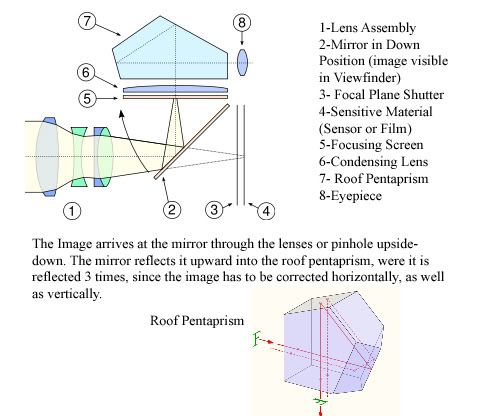
A Single-Lens Reflex camera allows the user to see, throught the viewfinder, the way the picture is to be taken. A mirror is set between the sensitive surface (sensor or film) and the lenses. The mirror is placed at a 45° angle, which makes the light beams, waves, or particles (whichever way you want to see it) travel upward, and hit a focusing screen. The image is proyected on the focusing screen. A roof pentaprism reflects the proyected image 3 times: The first reflection corrects vertical orientation, the second one the horizontal orientation of the image, and the third one reflects the image the way it is seen through the viewfinder. Generally, to add brightness to the image in the viewfinder, there is a condensing lens found between the focusing screen and the pentaprism.
Since the faces in a pentaprism cannot ensure Total Internal Reflection, given the entry angle of light, both reflective surfaces of the pentaprism have to be coated or overlapped with a reflective material.
In early SLRs, the mirror had to be lifted manually before a picture was taken. This made the SLR unpractical and useless for certain photographics tasks. When automatic mirror-rising was introduced, a new problem was born: the vibration caused by the mirror-lifting caused motion blur. Then, in 1959, the Nikon F introduced mirror lockup. Mirror Lock Up allows the mirror to be raised before the Shutter is opened. The vibration dies down , and no motion blur appears on the exposure.
In my previous posts, I’ve written about the historical development of photography, all the way back to Ibn Al-Hazen's Camara Obscura, and to more recent times, stopping at the huge development Japanese Optics Corporations had in the 1950's. I'm gonna take a break from the whole history lesson for now, and we'll start on engineering and physics, as to fully understand the way a Single-Lens reflex camera works.
A Single-Lens Reflex camera allows the user to see, throught the viewfinder, the way the picture is to be taken. A mirror is set between the sensitive surface (sensor or film) and the lenses. The mirror is placed at a 45° angle, which makes the light beams, waves, or particles (whichever way you want to see it) travel upward, and hit a focusing screen. The image is proyected on the focusing screen. A roof pentaprism reflects the proyected image 3 times: The first reflection corrects vertical orientation, the second one the horizontal orientation of the image, and the third one reflects the image the way it is seen through the viewfinder. Generally, to add brightness to the image in the viewfinder, there is a condensing lens found between the focusing screen and the pentaprism.
Since the faces in a pentaprism cannot ensure Total Internal Reflection, given the entry angle of light, both reflective surfaces of the pentaprism have to be coated or overlapped with a reflective material.
In early SLRs, the mirror had to be lifted manually before a picture was taken. This made the SLR unpractical and useless for certain photographics tasks. When automatic mirror-rising was introduced, a new problem was born: the vibration caused by the mirror-lifting caused motion blur. Then, in 1959, the Nikon F introduced mirror lockup. Mirror Lock Up allows the mirror to be raised before the Shutter is opened. The vibration dies down , and no motion blur appears on the exposure.
24 ago 2008
A (Very) Brief History of Photography (Part 3)
World War II had cost Japan millions of lives, and most of its industry and infrastructure was destroyed. Japan adopted a pacifist constitution with emphasis on liberal and democratic practices. In 1952, the allied occupation in Japan and in 1956, Japan was granted admission in the UN. This became the starting point for an spectacular economic growth in Japan for the next four decades. This is how Japanese SLRs came to be
Japan had been doing optics for some time then. Pentax (or Asahi, as it was then known) had military contracts for optical instruments during WWII. At the end of the war, the company was disbanded for three years, when in 1948 it was allowed to re-form.
In 1952, Asahi released the Asahiflex I, the first Japanese 35mm SLR. In 1954, the Asahiflex IIB became the first Japanese SLR with a return mirror.
By the end of the 1950’s, the SLR design was homogenized.
In May 1959, Canon introduced the Canonflex. The Canonflex featured a quick return mirror and an automatic diaphragm ("with Automatic Springback Diaphragm and Mirror"-1959 Canon Brochure). It was also the first camera to have Canon’s breech lock FD mount. In theory, the system made any mount a secure one. You only had to tighten the breech. When in practice, though, this turned out to be unpractical, since more time had to be devoted to attaching or removing the lenses. The Canon FD mount was used until 1987, when Canon introduced the EF lens mount, to be used with the Canon EOS cameras.
The Nikon F, releasedin March 1959, became enormously successful, and became the camera that demonstrated Japanese camera manufacturer’s superiority. The F featured Nikon’s 3-lug bayonet F mount, still used today with slight modifications to keep with the times. The F also featured many other elements that added up to its success:
1- An interchangeable prism and focusing screen system.
2- Mirror lockup, which reduced vibration, by making the mirror flip out of the light’s path just before the shutter opened.
3- A solid design, making it resistant to damage.
4- 100% viewfinder
5- It was released with a wide variety of lenses, ranging from 21mm to 1000 mm focal length.
Minolta released the SR-2 to global market the same the Canonflex and the F, although the SR-2 had been on sale in Japan since 1958. The SR-2 featured Minolta’s MD mount (still used today) along with a semi-automatic diaphragm.
Photography
Japan had been doing optics for some time then. Pentax (or Asahi, as it was then known) had military contracts for optical instruments during WWII. At the end of the war, the company was disbanded for three years, when in 1948 it was allowed to re-form.
In 1952, Asahi released the Asahiflex I, the first Japanese 35mm SLR. In 1954, the Asahiflex IIB became the first Japanese SLR with a return mirror.
By the end of the 1950’s, the SLR design was homogenized.
In May 1959, Canon introduced the Canonflex. The Canonflex featured a quick return mirror and an automatic diaphragm ("with Automatic Springback Diaphragm and Mirror"-1959 Canon Brochure). It was also the first camera to have Canon’s breech lock FD mount. In theory, the system made any mount a secure one. You only had to tighten the breech. When in practice, though, this turned out to be unpractical, since more time had to be devoted to attaching or removing the lenses. The Canon FD mount was used until 1987, when Canon introduced the EF lens mount, to be used with the Canon EOS cameras.
The Nikon F, releasedin March 1959, became enormously successful, and became the camera that demonstrated Japanese camera manufacturer’s superiority. The F featured Nikon’s 3-lug bayonet F mount, still used today with slight modifications to keep with the times. The F also featured many other elements that added up to its success:
1- An interchangeable prism and focusing screen system.
2- Mirror lockup, which reduced vibration, by making the mirror flip out of the light’s path just before the shutter opened.
3- A solid design, making it resistant to damage.
4- 100% viewfinder
5- It was released with a wide variety of lenses, ranging from 21mm to 1000 mm focal length.
Minolta released the SR-2 to global market the same the Canonflex and the F, although the SR-2 had been on sale in Japan since 1958. The SR-2 featured Minolta’s MD mount (still used today) along with a semi-automatic diaphragm.
Photography
23 ago 2008
A (Very) Brief History of Photography (Part 2)
Photography could only be made via the Daguerreotype and Collodion process exposure systems, both of which were unpractical, and required the photographer to carry a box full of toxic or potentially flammable substances around, along with the plates on which the photography was to be taken. In 1884, George Eastman created the first photographic film with nitrocellulose coated with a dry gel emulsion of silver halide salts.
In 1888, Eastman introduced his Kodak Camera, along with the famous slogan “You press the button, we do the rest”. This was true: the roll of film meant anyone could take a picture, without having to develop the picture almost immediately. In fact, the whole development process could be made by someone else. In 1901, Kodak introduced the famous “Brownie” (Henri Cartier-Bresson’s childhood favorite). The first Brownie was a simple box camera, made of cardboard, and with an initial price of $1 dollar.
In 1913, the 35 mm film format was introduced for still photography. The format was created by Thomas Alva Edison as a way to feed film into a camera through sprocket holes, when all other cameras used friction feed. Edison patented his invention, forcing his competitors to use friction feed until 1902, when a court ruling invalidated Edison’s claim, allowing any producer or distributor to use the film design without a license. The new film format was practical and smaller than other film designs, but wasn’t popular until Leica Camera introduced the Leica I, or Leica A, a precision miniature camera.
The 35 mm snapshot camera design introduced by Leica has not changed much in more than 80 years. But the next great milestone in photography came in 1936.
Single lens reflex cameras were invented 1861 by Thomas Sutton. The sole design of the SLR had been around for more than two centuries before photography was born: Artists would use Camara Obscura fitted with a mirror placed in a 45° angle, which would reflect the image into a ground glass, allowing the artist to make a realistic drawing by simply tracing over the glass.
Early SLRs were large format cameras, and not as popular as the standard View Cameras of the time. They had waist-level viewfinders, and the mirror, most often than not, had to be raised manually before the picture was taken.
In 1936, Dresden-based Company Ihagee released the Kine-Exakta, the first 35mm SLR.
Between 1936 and 1937, Zeiss started working on a 35 mm SLR. The camera used an eye level pentaprism, which allowed the image to be seen in a correct left-to-right orientation, since waist level cameras showed a reversed image. Additionally, a Fresnel lens was placed in between the ground glass and the pentaprism, thus brightening the image. This design became the conventional SLR design used today. The camera wasn’t introduced until 1949 as the Contax S, mainly because all production halted when World War II intervened.
Photography
In 1888, Eastman introduced his Kodak Camera, along with the famous slogan “You press the button, we do the rest”. This was true: the roll of film meant anyone could take a picture, without having to develop the picture almost immediately. In fact, the whole development process could be made by someone else. In 1901, Kodak introduced the famous “Brownie” (Henri Cartier-Bresson’s childhood favorite). The first Brownie was a simple box camera, made of cardboard, and with an initial price of $1 dollar.
In 1913, the 35 mm film format was introduced for still photography. The format was created by Thomas Alva Edison as a way to feed film into a camera through sprocket holes, when all other cameras used friction feed. Edison patented his invention, forcing his competitors to use friction feed until 1902, when a court ruling invalidated Edison’s claim, allowing any producer or distributor to use the film design without a license. The new film format was practical and smaller than other film designs, but wasn’t popular until Leica Camera introduced the Leica I, or Leica A, a precision miniature camera.
The 35 mm snapshot camera design introduced by Leica has not changed much in more than 80 years. But the next great milestone in photography came in 1936.
Single lens reflex cameras were invented 1861 by Thomas Sutton. The sole design of the SLR had been around for more than two centuries before photography was born: Artists would use Camara Obscura fitted with a mirror placed in a 45° angle, which would reflect the image into a ground glass, allowing the artist to make a realistic drawing by simply tracing over the glass.
Early SLRs were large format cameras, and not as popular as the standard View Cameras of the time. They had waist-level viewfinders, and the mirror, most often than not, had to be raised manually before the picture was taken.
In 1936, Dresden-based Company Ihagee released the Kine-Exakta, the first 35mm SLR.
Between 1936 and 1937, Zeiss started working on a 35 mm SLR. The camera used an eye level pentaprism, which allowed the image to be seen in a correct left-to-right orientation, since waist level cameras showed a reversed image. Additionally, a Fresnel lens was placed in between the ground glass and the pentaprism, thus brightening the image. This design became the conventional SLR design used today. The camera wasn’t introduced until 1949 as the Contax S, mainly because all production halted when World War II intervened.
Photography
8 jul 2008
Nueva Cámara Canon SLR Digital New Canon XS


CANON'S NEW EOS REBEL XS CAMERA LOOKS TO INSPIRE A NEW GENERATION OF DIGITAL SLR PHOTOGRAPHERS
Photographers Looking for the Next Step Up From Their Point-and-Shoot Camera Will Enjoy the High-End Features and Fun-to-Use SLR Technology of Canon's Newest Rebel Camera
LAKE SUCCESS, N.Y., July 8, 2008 – Canon U.S.A., Inc., a leader in digital imaging, today announced the introduction of the EOS Rebel XS, a new entry-level digital camera that affordably puts Canon SLR technology such as an Optical Imaged Stabilized lens and easy-to-use professional features into the hands of emerging photographers. Consumers looking to take their photography a step further and begin shooting with an SLR will find the transition easier than ever with Canon's new Rebel XS digital SLR camera. From the parent photographing a little league game, to the tourist shooting a wondrous new city, the Canon Rebel XS camera makes photography easy for everyone. Canon has also introduced the latest model in the EX series of Speedlite flashes: the Canon Speedlite 430EX II.
Ideal for a wide range of photographers from first-time digital SLR users to veteran photo enthusiasts, the new Canon EOS Rebel XS camera was designed to embody what customers have come to expect from the EOS Rebel series – a fast, non-intimidating, lightweight, easy-to-use camera that produces excellent images and starts emerging photographers off on the right foot. Immediately, photographers will take notice of the camera's Optical Image Stabilized kit lens for crisp focus, compensating for camera shake from unsteady hands or a moving vehicle. The new Rebel model also incorporates Canon's DIGIC III image processor, 10.1 megapixel CMOS sensor, Live View, Auto Lighting Optimizer, 7-point wide-area autofocus (AF) sensor and 3.0 frames per second continuous JPEG burst rate where the number of consecutive shots in a burst is only limited by the capacity of the flash memory card in the camerai.
"We are proud to introduce the new EOS Rebel XS camera at a very exciting time in digital imaging. As consumers have fully embraced digital photography, with many consumers purchasing their second or third digital camera models, we see the Rebel XS as the bridge to help photographers cross over from the world of point-and-shoot cameras to digital SLR technology," said Yuichi Ishizuka, senior vice president and general manager, Consumer Imaging Group, Canon U.S.A.
A first in Canon's EOS line-up, the Rebel XS camera's continuous JPEG burst rate allows users to continuously shoot a scene until the memory card is at capacity. This will be particularly helpful for new photographers looking to capture that perfect image of a moving subject.
The Live View function allows users to frame and shoot images in real time via the camera's 2.5 inch LCD screen, a great feature for users accustomed to framing shots via LCD monitors on point-and-shoot digital cameras. The Camera's Auto Lighting Optimizer detects dark areas of an image and automatically adjusts brightness and contrast to ensure optimal image results. The Canon Rebel XS allows greater ease of use through large control buttons and easy-to-see operating panel indications such as ISO settings visible through the viewfinder and Canon Speedlite controls through the camera LCD menu.
The Rebel XS incorporates an APS-C size (22.2 x 14.8 mm) CMOS sensor with 10.1 million pixel images and Canon's exclusive high-performance DIGIC III image processor to help deliver high levels of imaging performance and responsiveness. It also has Canon's exclusive EOS Integrated Cleaning System, which features both hardware and software-based dust removal technology. Additionally, weighing less than 1 lb./450 grams, this camera is the lightest body in the EOS digital series camera lineup.
The EOS Rebel XS camera is compatible with Canon's extensive lineup of more than 60 EF and EF-S lenses, including the Image Stabilizer-equipped EF-S18-55mm f/3.5-5.6 IS, which is included in the camera's standard zoom lens kit package. The Canon Rebel XS will be available in black or silver colored body variations.
Canon Speedlite 430EX II
The new Canon Speedlite 430EX II, which succeeds the 430EX, realizes an approximately 20 percent reduction in recycling time compared with its predecessor. Like the 580EX II, the 430EX II allows users to control flash functions and input settings using the camera's LCD monitorii, and also offers a quick-lock attachment system and a metal mounting foot for improved contact reliability and durability. The new Canon Speedlite 430EX II will carry an estimated retail price of $329.99.
In the Box
Expected to ship in August 2008 the Canon Rebel XS camera is available in a zoom lens kit version, which includes the EF-S18-55mm f/3.5-5.6 IS zoom lens, a rechargeable battery pack and charger, USB and video cables, a neckstrap, an EOS Solutions Disk CD, and a 1-year Canon U.S.A., Inc. limited warranty. The new camera's estimated retail price is $699.99.
Though standard in the EOS Rebel XS kit, the EF-S 18-55mm f/3.5-5.6 IS lens is also available as a stand-alone purchase and carries an estimated retail price of $199.99.
About Canon U.S.A., Inc.
Canon U.S.A., Inc. delivers consumer, business-to-business, and industrial imaging solutions. Its parent company, Canon Inc. (NYSE:CAJ), a top patent holder of technology, ranked third overall in the U.S. in 2007†, with global revenues of $39.3 billion, is listed as one of Fortune's Most Admired Companies in America and is on the 2007 BusinessWeek list of "Top 100 Brands." To keep apprised of the latest news from Canon U.S.A., sign up for the Company's RSS news feed by visiting www.usa.canon.com/pressroom.
# # #
† IFI Patent Intelligence Press Release, January 2008
All referenced product names, and other marks, are trademarks or registered trademarks of their respective owners.
Availability, prices, and specifications of all products are subject to change without notice. Actual prices are set by individual dealers and may vary.
--------------------------------------------------------------------------------
i Based on Canon testing using a 2GB SD memory card when shooting JPEG images.
ii When using the EOS-1Ds Mark III, EOS-1D Mark III, EOS 40D, EOS Rebel XSi, EOS Rebel XS, PowerShot G9 or PowerShot S5 IS.
Suscribirse a:
Entradas (Atom)